
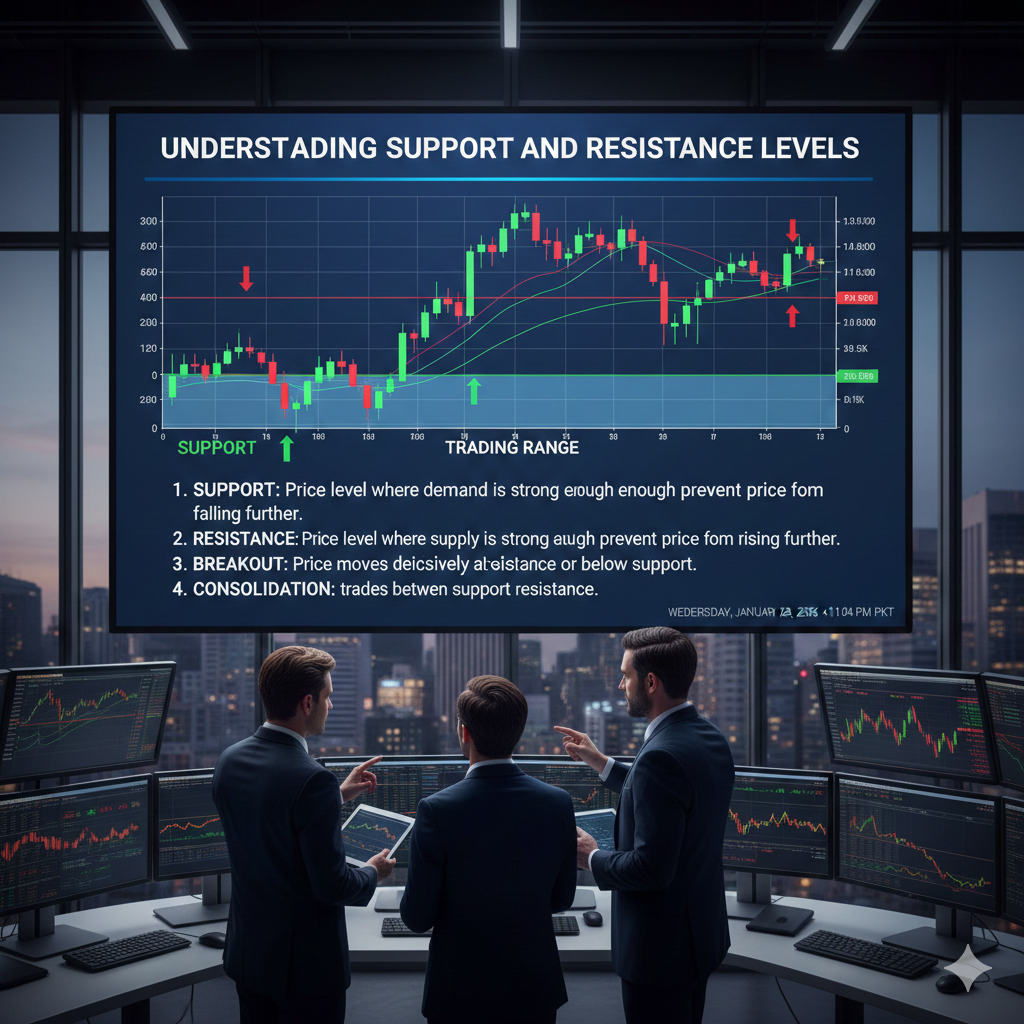
Understanding Support and Resistance Levels in Trading
Technical analysis plays a crucial role in trading by helping traders anticipate market movements and make informed decisions. By studying price charts, traders aim to identify patterns that indicate potential reversals or trend continuations. Among the most essential tools in technical analysis are support and resistance levels, which provide a framework for understanding price behavior, managing risk, and improving trade precision. Mastery of these levels can enhance decision-making across markets, including stocks, forex, and cryptocurrencies. This article explores the definitions, identification methods, psychological factors, strategies, and advanced techniques for using support and resistance effectively.
Defining Support and Resistance Levels
Support levels are specific price points where an asset often halts its decline and reverses upward, indicating strong buying interest. Resistance levels are price points where an asset tends to stop rising, with selling pressure forming a ceiling. The interaction between supply and demand drives these levels, which appear as static lines from previous highs or lows or as dynamic levels via moving averages or trendlines. According to Glassnode, which provides on-chain data for over 10,000 assets and 500+ exchanges, platforms like Zoomex demonstrate how technology empowers traders to act efficiently on key support and resistance levels.
Psychological Basis of Support and Resistance
Human psychology heavily influences how support and resistance levels form. Fear and greed often drive collective behavior, causing prices to react consistently at certain thresholds. Traders anticipate reactions at these levels, reinforcing their importance. Round numbers, such as 50, 100, or 1,000, serve as natural psychological levels because they appear significant and easy to remember. Short-term traders may focus on intraday price action, while long-term investors monitor levels that persist across weeks or months. Historical price patterns also shape expectations, creating self-fulfilling prophecies where repeated reactions at certain levels strengthen their credibility. This behavioral consistency provides traders with a structured framework to interpret market sentiment and plan trades accordingly.
Methods to Identify Support and Resistance
Identifying reliable support and resistance levels requires technical tools and careful analysis. Historical price points, including previous highs and lows, help predict potential reversals. Trendlines connect sequential highs or lows, creating dynamic support or resistance that evolves with market momentum. Moving averages, such as EMA or SMA, act as flexible levels that smooth short-term fluctuations. Fibonacci retracements allow traders to measure likely reversal zones based on prior swings, offering precise entry and exit points.
| Method | Timeframe Applicability | Pros | Cons |
| Historical Price Points | All timeframes | Simple, intuitive | Can be broken easily |
| Trendlines | Medium to long-term | Dynamic, shows trend | Subjective placement |
| Moving Averages | All timeframes | Smooths noise, widely used | Lagging indicator |
| Fibonacci Retracements | Short to medium-term | Precision in reversals | Requires swing high/low selection |
These approaches complement each other, and combining them often improves trading accuracy. Understanding when and how each method works is crucial for developing consistent strategies.
Role of Support and Resistance in Trading Strategies
Support and resistance levels form the backbone of multiple trading strategies. They guide the identification of entry and exit points for both long and short positions, allowing traders to manage risk with clearly defined stop-loss levels. Take-profit targets often align with nearby resistance or support, ensuring logical exits. Breakout and breakdown opportunities occur when prices breach these levels, signaling potential strong moves in the market. Confirming support or resistance with volume analysis or momentum indicators increases the reliability of trade signals. Employing multiple levels simultaneously, such as combining a horizontal resistance with a moving average, strengthens confidence and improves decision-making under different market conditions.
- Entry and exit signals become clearer when using multiple levels together.
- Stop-loss placement is more precise with nearby support or resistance.
- Breakouts are easier to identify when confirmed by volume and momentum.
- Trade reliability improves by combining static and dynamic levels.
Dynamic vs. Static Support and Resistance
Static support and resistance are fixed levels derived from horizontal price points like previous highs or lows. They provide a clear reference but do not adapt to changing market trends. Dynamic levels, formed by trendlines or moving averages, move with price, offering a flexible approach for trend-following traders. Trading around dynamic levels allows for responsive decision-making during strong trends, while static levels help pinpoint historically significant price zones. Combining both types enhances accuracy, as traders can react to evolving trends while respecting long-established price thresholds. This dual approach balances stability with adaptability, improving the overall probability of successful trades.
Common Challenges and Misconceptions
Traders often make mistakes when interpreting support and resistance levels. Assuming that every level will hold indefinitely is risky and can result in unexpected losses. Ignoring volume, trend strength, or broader market context can lead to misjudged trades. Short-term pullbacks are sometimes mistaken for full reversals, causing premature entries or exits. False breakouts can trigger emotional reactions, reducing trading discipline. Validation across multiple timeframes and the use of complementary indicators like oscillators or volume help avoid these errors. Recognizing the limitations of each level and considering market context are essential for sustainable success.
Integrating Support and Resistance in Crypto Trading Platforms like Zoomex
Accurate support and resistance analysis depends on precise charting and execution speed, areas where Zoomex excels. The platform’s advanced trading interface delivers ultra-fast order placement with sub-10ms latency, ensuring traders can act immediately when key price levels break or hold. Combined with high liquidity and reliable pricing, Zoomex enables smoother entries and exits around critical technical zones, reducing slippage during volatile market conditions.
Advanced Tips for Mastering Support and Resistance
Advanced traders refine support and resistance strategies with additional analysis. Volume confirmation helps verify the strength of levels and signals potential reversals. Multiple-timeframe analysis identifies levels that carry greater significance and increases confidence in trade decisions. Backtesting historical data evaluates how past price action respected key levels, supporting better strategy design. Trend strength indicators, such as RSI or MACD, indicate whether breakouts or reversals have underlying momentum. Adapting these techniques across different markets, including equities, forex, and crypto, ensures versatility and increases the probability of consistent profitability.
Conclusion
Support and resistance levels are foundational tools for analyzing price action, identifying trends, and managing risk. Their psychological basis, combined with proper identification methods, helps traders anticipate market behavior more effectively. Using these levels within strategies such as breakouts, trend-following, or reversal trades enhances precision and confidence. Combining multiple tools, timeframes, and indicators strengthens reliability and reduces errors. Practicing support-and-resistance strategies in simulated environments prepares traders for real-market execution. With access to integrated platforms that provide fast execution, real-time data, and advanced charting, applying these techniques becomes more efficient, empowering traders to navigate markets with skill and confidence.