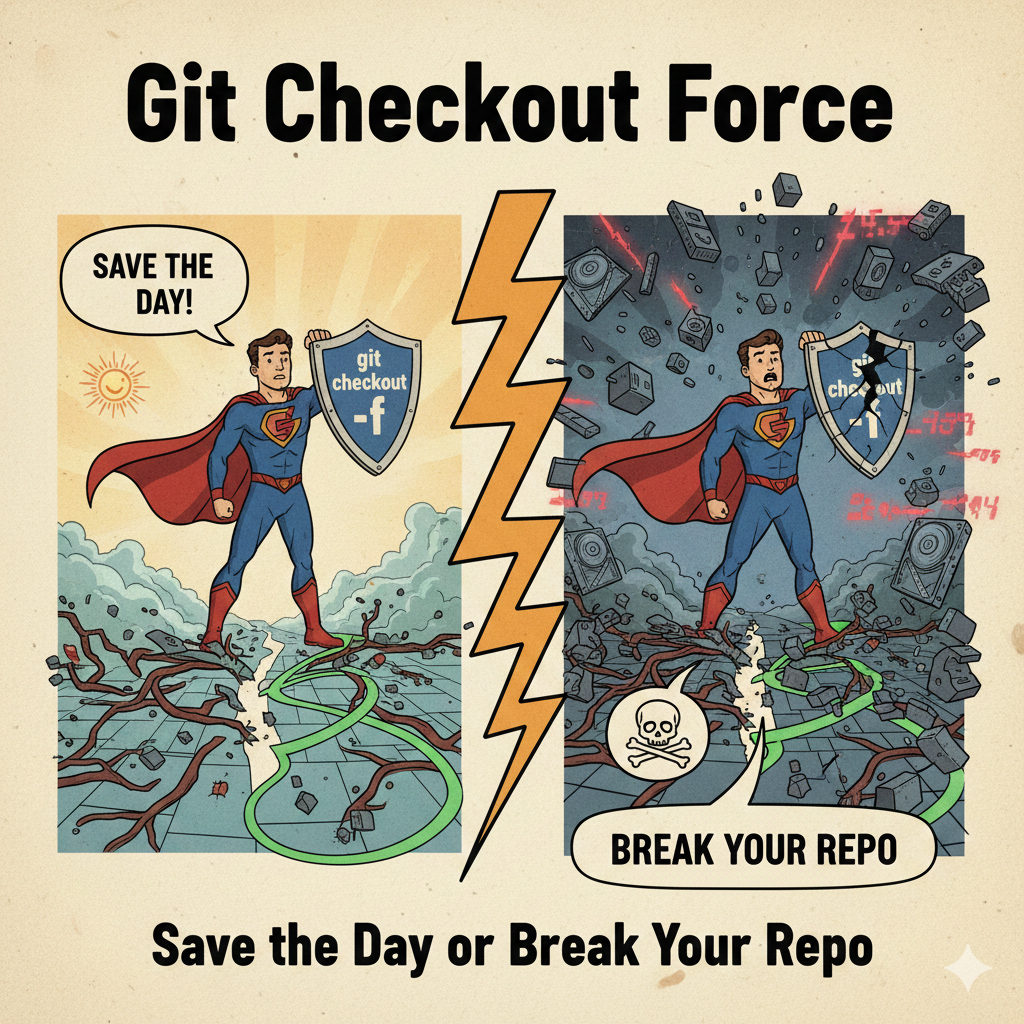
Git Checkout Force: Save the Day or Break Your Repo
It usually starts with confidence.
You’re in the middle of a quick fix, a small experiment, or maybe a change you never meant to keep. You try to switch branches, and Gitstops you.
An error appears. Local transformations
One command later, the branch switches cleanly, no warnings, no errors. Everything looks fine. Until it doesn’t.
This is the moment when most developers truly understand what gitcheckout force can do.
It can absolutely save your day. And just as easily, it can break your repo, or at least make it feel that way.
What “Git Checkout Force” Really Means
When developers talk about git checkout force, they’re referring to this command:
Git checkout -f branch-name
Or, in newer versions of Git:
Git switch -f branch-name
The -f flag stands for force, and it tells Git something particular:
Ignore any local changes and switch branches anyway.
Normally, Git protects you. If you have doubtful changes and try to switch branches, Git blocks the action.
That safeguard exists for a reason: It prevents accidental data loss. Force checkout removes that protection. When you use it, Git stops negotiating.
It doesn’t collect or save your work. It doesn’t ask if you’re sure. It simply resets your working directory to match the target branch and moves on. If you had uncommitted changes, they are discarded.
Why Developers Reach for Force Checkout
Despite the risks, force checkout exists because it can sometimes be precisely what you need.
Developers use it when:
In these circumstances, a git checkout force can genuinely save the day.
It’s fast, it’s decisive, it clears the slate without ceremony. The problem is that it feels safe even when it isn’t.
The Subtle Danger: It Fails Quietly
“Dangerous” commands are the most clear. They trigger errors and crashes and prompt you for an answer.
Git checkout– force, instead, does nothing on the list above. If it succeeds, it does so silently.
It is this silent technology that is the threat. There is no feedback to recognize that you have accomplished the impossible. Instead, you know it is finished.
The terminal turns back control. Your editorrefresheshelloWorld.txt. Life moves on.
It’s only when searching for a file or browsing through a diff view that the nagging feeling arises: “Hey, something’s missing here.”
A Familiar “How Did This Happen?”
This is how many force checkout disasters grow:
You’re working on a feature and have made several changes, but nothing you’re not ready to commit yet. You just need to switch branches quickly to check something.
Git stops you.
You know the changes aren’t perfect, but they’re not useless either. You hesitate for a moment, then decide you can redo them later if you have to. So you add the -f flag.
The branch switches instantly. At first, everything looks normal. Then you notice one file is missing. Then another. Soon, your editor shows no modified files.
The work is gone. Git did exactly what you asked.
When Git Checkout Force Actually Saves You
It’s important to say this clearly: force checkout is not a bad command.
Used intentionally, it’s beneficial.
It makes sense when:
In these moments, force checkout can save time, reduce mental load, and let you move forward without friction. The key difference is intention.
Why “I’ll Be Able to Recover It” Is a Dangerous Thought
One of the most common assumptions developers make is that lost work can always be recovered.
Sometimes it can, but often it can’t.
Git does not track uncommitted changes in a way that guarantees recovery. Once force checkout overwrites those changes, Gitconsiders the operation complete and successful.
You might get lucky with:
But none of these are guaranteed. Force checkout is irreversible.
Safer Alternatives Before You Use Git Force
Before running git checkout force, there are safer options that take only seconds longer.
Commit Your Work (Even Temporarily)
A quick commit protects everything:
Git commit -am “WIP.”
You can amend, squash, or delete it later. A bad commit is better than lost work.
Stash Changes Instead
git stash
git checkout branch-name
Stashing is reversible. Force checkout is not.
Check Your Status First
git status
If you see anything you might want after, don’t force it.
Git Switch Doesn’t Change the Risk
Git introduced git switch to make branch operations more transparent, but the force flag behaves the same way:
Git switch -f branch-name
Different command, same outcome.
Force is force, no matter the syntax.
How Skilled Developers Use Force Checkout
Senior developers don’t avoid force checkout; they treat it with consideration.
They:
The difference isn’t skill, it’s a mindset.
The Rule That Prevents Most Mistakes
Before using git checkout force, ask yourself one simple question:
“If this code disappears forever, am I okay with that?”
If the answer isn’t an immediate yes, stop.
Commit it. Stash it. Copy it somewhere. Do anything except force it.
Power isn’t the problem.
Git checkout– force doesn’t randomly ruin repos. It only does what you tell it to do.
The problem starts when we assume we understand the impact more than we actually do.
When you do know precisely what you’re discarding (and you’re okay with losing it), force checkout can be a lifesaver. It clears the mess and lets you move on fast.
The risk isn’t the command. It’s the assumptions we make before running it.
Use it intentionally.
Use it lightly.
And never forget that Git will always do precisely what you tell it to do.