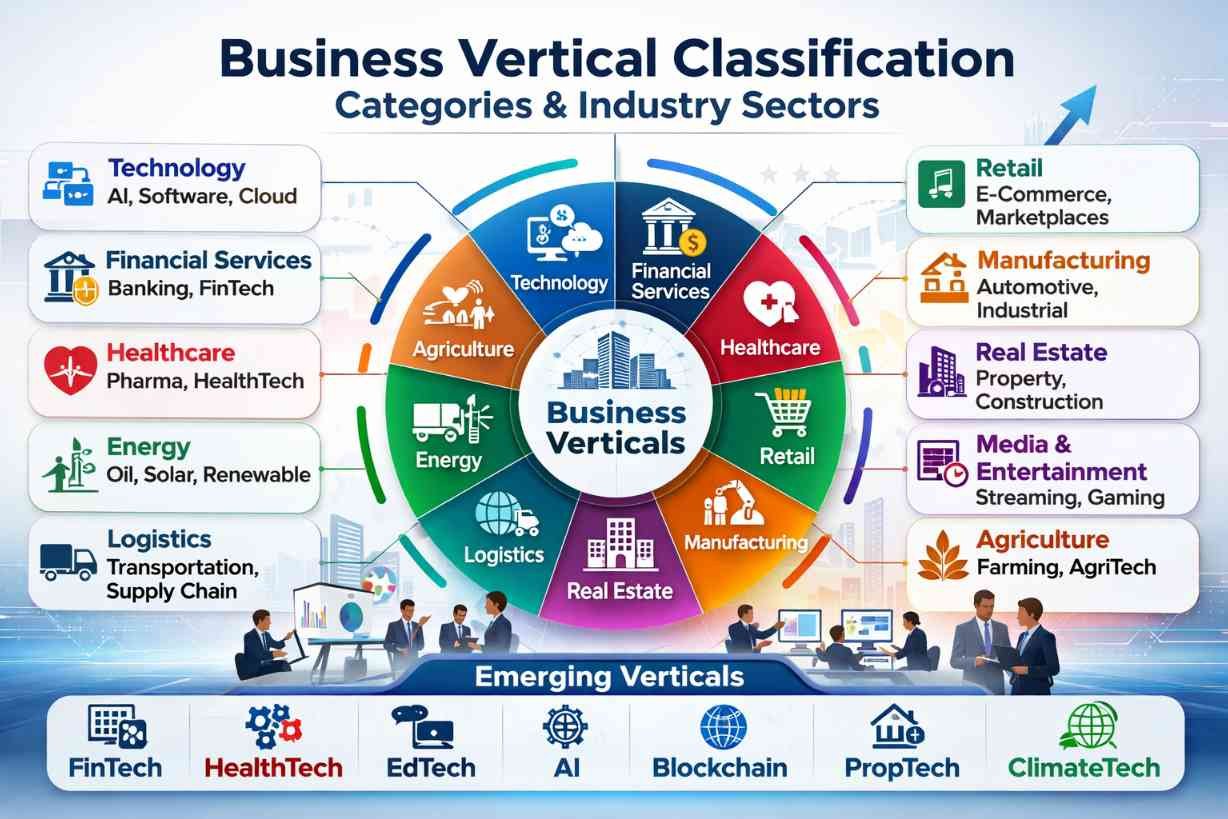
Business Vertical Classification Categories: A Simple Guide
Businesses around the world operate in many different industries. To better understand these industries, companies and analysts use something called business vertical classification. This system groups businesses based on the type of products or services they offer. Business vertical classification makes it easier to study markets, identify competitors, and understand how industries work. It is used by businesses, investors, governments, and researchers to organize economic activities into clear categories.
In this article, we will explain business vertical classification in simple language, including its structure, major categories, and examples.
What Is Business Vertical Classification?
Business vertical classification is the process of grouping companies based on the industry they operate in. Each vertical represents a specific market that focuses on certain products, services, or customer needs.
For example:
-
A company that develops banking apps belongs to the FinTech vertical.
-
A company that produces medicines belongs to the healthcare vertical.
-
A company that sells clothes online belongs to the retail vertical.
These classifications help people understand how businesses are connected within the economy.
Vertical Markets vs Horizontal Markets
Businesses can operate in vertical markets or horizontal markets.
| Feature | Vertical Market | Horizontal Market |
|---|---|---|
| Definition | Focuses on one specific industry | Serves many industries |
| Products | Specialized products | General-purpose products |
| Target customers | Industry-specific customers | Businesses from many industries |
| Example | Hospital management software | Accounting software |
Vertical markets provide solutions designed for specific industries, while horizontal markets provide tools that can be used by many industries.
Why Business Vertical Classification Is Important
Business vertical classification helps companies and organizations understand industries more clearly.
Main Benefits
-
Helps businesses find their target market
-
Makes it easier to analyze competitors
-
Helps investors compare companies
-
Supports better business planning
-
Helps sales teams focus on the right industries
-
Helps governments study economic growth
Who Uses Vertical Classification?
| User | Purpose |
|---|---|
| Businesses | Identify customers and competitors |
| Investors | Analyze industry opportunities |
| Governments | Track economic performance |
| Researchers | Study industry trends |
| Marketers | Target specific industries |
Business Classification Structure
Most classification systems organize industries into different levels. These levels move from broad sectors to very specific niches.
| Level | Description | Example |
|---|---|---|
| Sector | Large part of the economy | Technology |
| Industry Group | Related industries | Software & IT Services |
| Industry | Specific market area | Cloud Software |
| Sub-Industry / Vertical | Specialized niche | Cybersecurity |
This structure helps businesses understand where they fit within the market.
Major Business Vertical Categories
Below are the most common business verticals in today’s economy.
1. Technology
The technology vertical includes companies that create digital products and services.
Examples of Technology Industries
-
Software development
-
Cloud computing
-
Cybersecurity
-
Artificial intelligence
-
Data analytics
-
Hardware manufacturing
| Technology Sub-Vertical | Description |
|---|---|
| SaaS | Software delivered through the internet |
| AI | Machines that learn and make decisions |
| Cybersecurity | Protecting digital systems |
| Cloud Computing | Online storage and computing services |
Technology affects many other industries because most businesses rely on digital tools.
2. Financial Services
The financial services vertical deals with money management and financial transactions.
Key Financial Industries
-
Banking
-
Investment services
-
Insurance
-
Payment systems
-
Lending services
| Financial Sub-Vertical | Description |
|---|---|
| FinTech | Technology used in financial services |
| Digital Banking | Online banking platforms |
| WealthTech | Technology for managing investments |
| InsurTech | Technology used in insurance |
Digital innovation is changing how people manage money.
3. Healthcare and Life Sciences
Healthcare businesses focus on improving human health and providing medical services.
Main Healthcare Industries
-
Hospitals and clinics
-
Pharmaceutical companies
-
Biotechnology firms
-
Medical device companies
-
Telemedicine services
| Healthcare Sub-Vertical | Description |
|---|---|
| HealthTech | Technology for healthcare |
| Telemedicine | Remote healthcare services |
| Biotechnology | Research using living organisms |
| Medical Devices | Equipment used in treatment |
Healthcare is one of the most important industries in the world.
4. Retail and Consumer Commerce
Retail businesses sell products directly to consumers.
Retail Industry Segments
-
E-commerce stores
-
Physical retail stores
-
Electronics retailers
-
Clothing brands
-
Grocery stores
| Retail Sub-Vertical | Description |
|---|---|
| E-commerce | Online shopping platforms |
| Direct-to-Consumer | Brands selling directly to customers |
| Marketplaces | Platforms that connect buyers and sellers |
Online shopping has greatly changed the retail industry.
5. Manufacturing and Industrial
Manufacturing companies produce physical products using machines and factories.
Industrial Industries
-
Automobile manufacturing
-
Aerospace production
-
Machinery manufacturing
-
Electronics production
-
Industrial automation
| Manufacturing Sub-Vertical | Description |
|---|---|
| Robotics | Automated machines |
| Industrial IoT | Smart factory systems |
| 3D Printing | Layer-by-layer product creation |
Manufacturing is essential for global production and trade.
6. Real Estate and Construction
This vertical includes businesses that build, sell, and manage property.
Real Estate Segments
-
Residential housing
-
Commercial property
-
Construction services
-
Infrastructure development
Read also: Mietmakler
| Real Estate Sub-Vertical | Description |
|---|---|
| PropTech | Technology used in real estate |
| Smart Buildings | Technology-enabled properties |
| Property Management | Managing real estate assets |
Cities continue to grow, increasing demand for construction and real estate services.
7. Media and Entertainment
The media vertical focuses on creating and sharing content for audiences.
Entertainment Industries
-
Film production
-
Television networks
-
Streaming platforms
-
Video games
-
Music production
| Media Sub-Vertical | Description |
|---|---|
| Streaming | Online video and music services |
| Gaming | Video game development |
| AdTech | Digital advertising technology |
Digital platforms have changed how people consume entertainment.
8. Transportation and Logistics
Transportation and logistics companies move goods and people from one place to another.
Logistics Industries
-
Freight transportation
-
Airlines
-
Rail transport
-
Shipping companies
-
Delivery services
| Logistics Sub-Vertical | Description |
|---|---|
| Last-mile delivery | Final delivery to customers |
| Supply chain platforms | Logistics management systems |
| Smart logistics | Technology-based transportation |
E-commerce growth has increased demand for logistics services.
9. Energy and Utilities
Energy companies produce and distribute power.
Energy Industries
-
Oil and gas
-
Solar energy
-
Wind energy
-
Power generation
-
Energy storage
| Energy Sub-Vertical | Description |
|---|---|
| Renewable Energy | Sustainable power sources |
| CleanTech | Environment-friendly energy solutions |
| Energy Storage | Battery storage systems |
The world is moving toward cleaner and renewable energy.
10. Agriculture and Food
Agriculture supports global food production.
Agriculture Industries
-
Crop farming
-
Livestock farming
-
Food processing
-
Fisheries
| Agriculture Sub-Vertical | Description |
|---|---|
| AgriTech | Technology used in farming |
| Food Supply Chain | Food production and distribution |
| Precision Agriculture | Data-driven farming |
Technology is helping farmers improve productivity.
Emerging Business Verticals
New technologies are creating entirely new industries.
Examples of Emerging Verticals
-
Artificial intelligence
-
Blockchain technology
-
Internet of Things (IoT)
-
Climate technology
-
Space technology
| Emerging Vertical | Impact |
|---|---|
| AI | Automation and smarter systems |
| Blockchain | Secure digital transactions |
| IoT | Connected smart devices |
| ClimateTech | Solutions for climate problems |
These industries are expected to grow rapidly in the future.
Hybrid Business Verticals
Some modern industries combine multiple sectors.
| Hybrid Vertical | Combination |
|---|---|
| FinTech | Finance + Technology |
| HealthTech | Healthcare + Technology |
| EdTech | Education + Technology |
| PropTech | Real Estate + Technology |
| InsurTech | Insurance + Technology |
These hybrid industries are becoming more common as technology advances.
Common Industry Classification Systems
Several global systems are used to classify businesses.
| Classification System | Purpose |
|---|---|
| NAICS | Industry classification used in North America |
| SIC | Older industry classification system |
| GICS | Global classification used by investors |
| ICB | Industry classification benchmark |
| TRBC | Refinitiv business classification |
These systems help analysts compare companies across markets.
Challenges in Business Classification
Classifying businesses is not always easy.
Common Challenges
-
Rapid technology changes
-
Companies operating in many industries
-
Overlapping business models
-
Global market differences
For example, a large company may operate in technology, retail, and logistics at the same time, making classification difficult.
The Future of Business Vertical Classification
As industries evolve, classification systems are also improving.
Future Trends
-
Artificial intelligence used for industry analysis
-
Real-time market data classification
-
More flexible industry categories
-
Ecosystem-based industry mapping
These improvements will help analysts better understand complex markets.
Conclusion
Business vertical classification categories help organize the global economy into clear and understandable industries. By grouping companies into sectors, industries, and specialized verticals, businesses and analysts can better study markets and make informed decisions.
From traditional industries like agriculture and manufacturing to emerging sectors such as artificial intelligence and climate technology, vertical classification continues to evolve as the business world changes. Understanding these classifications allows companies to identify opportunities, analyze competitors, and grow more effectively in their chosen industries.