Active Recall vs. Passive Reading: Why Your 2026 Exam Strategy Needs a Digital Reset
There’s a ritual most of us remember from school: grab a highlighter, open the textbook, and paint the pages yellow until they look important. It felt productive. It looked productive. But according to a growing body of cognitive science research, it was barely productive at all. A landmark meta-analysis published in Psychological Science in the Public Interest found that passive techniques like highlighting and rereading ranked among the least effective study strategies tested. And yet, for millions of test-takers heading into certification season this year, the highlighter remains the weapon of choice. Georgia
The problem isn’t effort. It’s method. And as exam formats evolve, the gap between how people study and how they’re tested is becoming a serious liability.
The Forgetting Curve Is Working Against You
In the 1880s, German psychologist Hermann Ebbinghaus documented what he called the “forgetting curve” — a steep, predictable decline in memory retention that begins within minutes of learning something new. Without reinforcement, the average person forgets roughly half of newly learned material within a day and up to 90 percent within a week. That finding has been replicated countless times since, and it carries a blunt message for anyone preparing for a high-stakes exam: if your study plan relies on reading material once and hoping it sticks, the math is working against you.
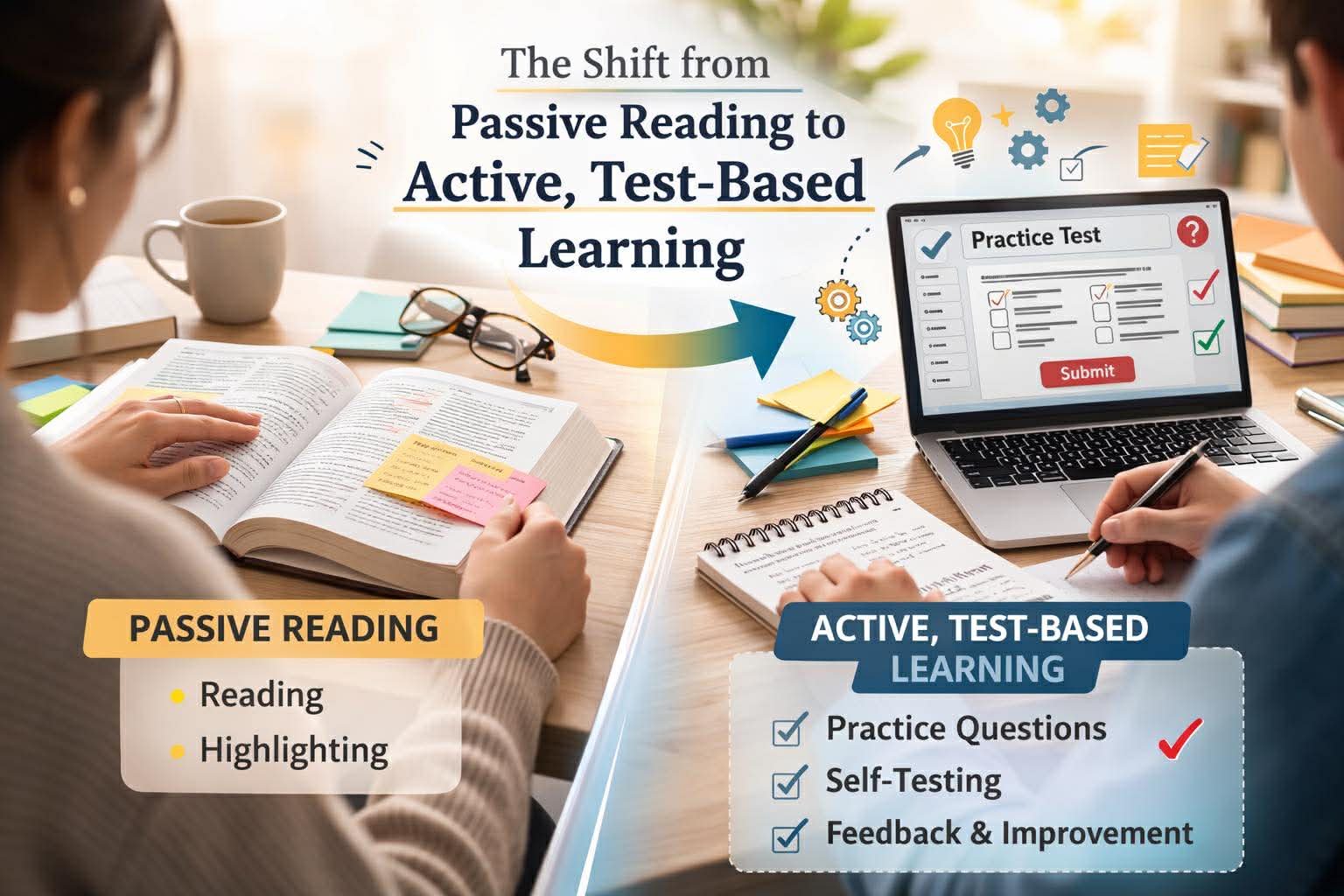
Active recall — the practice of forcing your brain to retrieve information rather than passively reviewing it — is the strongest known countermeasure. When you close the book and try to answer a question from memory, you strengthen the neural pathway to that knowledge. Research from Washington University in St. Louis found that students who used retrieval practice retained about 80 percent of material after a week, compared to roughly 35 percent for those who simply reread. That’s not a marginal improvement. It’s a completely different trajectory.
Computer-Adaptive Testing Changed the Game
Here’s where the story gets more interesting for anyone preparing for a major exam in 2026. Most high-profile professional certifications — from the CPA and NCLEX to the GRE and a growing roster of IT credentials — now use Computer Adaptive Testing, or CAT. Unlike a traditional fixed-form test where every candidate sees the same questions, a CAT engine adjusts in real time. Answer correctly, and the next question gets harder. Stumble, and the algorithm recalibrates downward. Your final score isn’t just about what you know; it’s about how consistently you perform under escalating pressure.
This is where passive study methods fall apart completely. You can memorize a glossary of terms and still freeze when a CAT exam presents a scenario-based question that demands applied reasoning in forty-five seconds. The format rewards depth, adaptability, and composure — none of which you develop by rereading chapter summaries.
Training Under Realistic Conditions
Athletes don’t prepare for a marathon by walking around the block. Musicians don’t prepare for a recital by reading sheet music silently. Yet test-takers routinely prepare for timed, pressurized, adaptive exams by sitting quietly with a study guide. The disconnect is obvious once you see it.
In the era of computer-adaptive testing, simply knowing the facts isn’t enough; you have to know how to apply them under pressure. The most efficient way to train your brain is through repeated, high-fidelity simulation. By taking a diagnostic practice test 2026, you can identify subconscious knowledge gaps and build the mental endurance required for the four-hour marathons that define modern professional certification. That kind of targeted, feedback-driven practice doesn’t just fill gaps — it teaches you how to think under the specific conditions you’ll face on test day.
The Bottom Line
There is no ambiguity in the science. Active recall develops true expertise, while passive reading produces the cozy appearance of familiarity. The penalty for adhering to antiquated study techniques increases each as exam formats become more complex. The best investment you can make in 2026 is not another prep book, regardless of whether you’re pursuing a professional license or admittance to graduate school. It’s a tactic that makes your brain work harder before the test rather than on it.